
 WORKS COVERED BY A 30 YEAR GUARANTEE
Timber decay is one of the most serious issues that can affect any property, whether residential or commercial. If left untreated, fungal decay can spread quickly, weakening structural timbers and leading to costly repairs. Two of the most common forms of timber decay found in UK buildings are dry rot and wet rot.
At Insite Group, we provide professional investigation, treatment and repair services for dry rot and wet rot across Hampshire and surrounding areas. With experienced specialists and a practical approach to building maintenance, we identify the root cause of timber decay and deliver long-term solutions that protect your property.
Understanding the difference between dry rot and wet rot is essential in preventing serious structural damage and maintaining the safety and integrity of your building.
What Is Dry Rot?
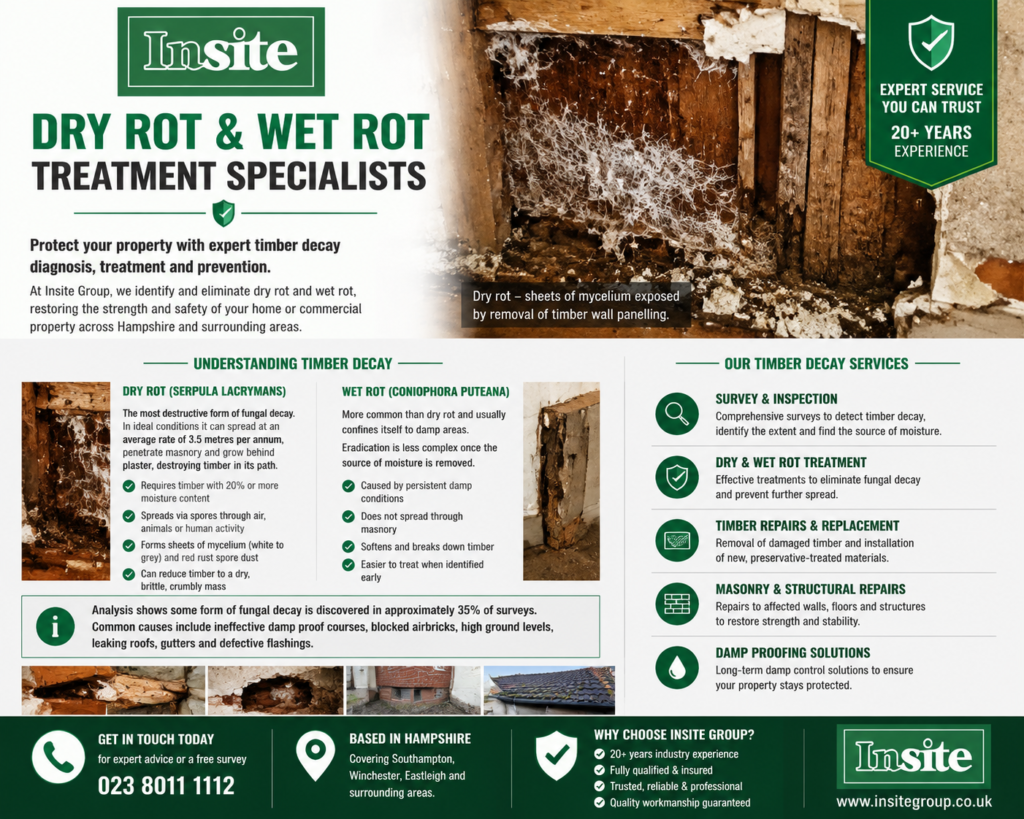
Dry rot (Serpula lacrymans) is the most severe form of fungal decay affecting timber in buildings. Despite its name, dry rot requires moisture to develop, but once established it can continue spreading through relatively dry areas by transporting moisture through its growth structure.
Dry rot is particularly dangerous because it can spread rapidly and silently behind walls, under floors and through masonry.
In ideal conditions, dry rot can spread at an average rate of up to 3.5 metres per year, making early detection and treatment essential.
How Dry Rot Develops
Dry rot begins when fungal spores enter a building through air currents, animals or human activity. When these spores land on timber with a moisture content above approximately 20%, they begin to germinate.
Once active, the fungus develops fine thread-like structures known as hyphae, which penetrate deep into the timber. These hyphae break down the wood by releasing enzymes that digest the cellulose and extract nutrients.
As the decay progresses, the timber becomes weak, brittle and structurally unsound.
In advanced stages, dry rot may produce a visible mycelium growth, which can appear as a cotton-like or sheet-like fungus ranging in colour from white to grey. Fruiting bodies may also develop, releasing red or rust-coloured spores into the surrounding environment.
Signs of Dry Rot
Dry rot can be difficult to detect in its early stages, but common warning signs include:
- Cracked or shrinking timber
- Musty or damp smell
- Grey or white fungal growth
- Brittle or crumbling wood
- Structural weakening of floors or beams
- Red dust-like spores in affected areas
Because dry rot can spread behind surfaces, visible signs often indicate a much larger hidden problem.
What Is Wet Rot?
Wet rot (Coniophora puteana) is a more common but less aggressive form of fungal decay compared to dry rot. It occurs when timber is exposed to persistent moisture over time.
Unlike dry rot, wet rot does not spread through masonry or dry areas. It remains confined to damp environments, making it easier to control once the source of moisture is identified.
However, wet rot can still cause significant structural damage if ignored.
How Wet Rot Occurs
Wet rot develops when timber remains in contact with excessive moisture due to issues such as:
- Leaking roofs
- Defective guttering
- Poor drainage
- Rising damp
- Condensation issues
- Blocked air bricks
- Faulty plumbing
When timber moisture levels remain high for prolonged periods, fungal spores begin to colonise the wood, breaking it down over time.
Signs of Wet Rot
Common indicators of wet rot include:
- Darkened or softened timber
- Cracked or distorted wood surfaces
- Damp or musty smell
- Localised decay areas
- Loss of structural strength in timber sections
Wet rot tends to remain localised, but untreated cases can still lead to serious structural concerns.
Key Differences Between Dry Rot and Wet Rot
Although both types of decay affect timber, there are important differences:
Dry rot:
- Spreads through masonry and plaster
- Can travel long distances
- More aggressive and destructive
- Requires urgent specialist treatment
Wet rot:
- Remains confined to damp areas
- Does not spread through masonry
- Easier to control
- Usually linked to local moisture sources
Understanding the type of decay is essential in selecting the correct treatment approach.
Our Dry Rot Treatment Process
At Insite Group, we follow a structured and effective approach to dry rot treatment:
1. Survey and Inspection
We carry out a detailed inspection to identify the extent of the infestation and locate the source of moisture.
2. Removal of Affected Timber
All contaminated or structurally weakened timber is carefully removed.
3. Source Elimination
We identify and resolve the underlying moisture problem, such as leaks or ventilation issues.
4. Masonry Treatment
Affected masonry is treated to prevent further fungal growth.
5. Replacement and Reinstatement
New treated timber is installed to restore structural integrity.
Wet Rot Treatment Approach
Wet rot treatment focuses on controlling moisture and replacing affected materials:
- Identifying moisture sources
- Improving ventilation
- Removing damaged timber
- Treating surrounding areas
- Installing new treated timber
By addressing the root cause, we prevent recurrence and restore structural stability.
Why Early Treatment Is Essential
Timber decay does not improve on its own. If left untreated, both dry rot and wet rot can lead to:
- Structural instability
- Costly repairs
- Unsafe living conditions
- Spread of fungal decay
- Damage to surrounding building materials
Early intervention helps reduce repair costs and prevents further deterioration.
Professional Timber Decay Specialists
At Insite Group, we understand that dealing with timber decay can be stressful for property owners. Our experienced team provides clear guidance, accurate diagnosis and practical solutions tailored to each property.
We work across domestic and commercial buildings, ensuring minimal disruption while delivering effective long-term protection.
Why Choose Insite Group?
We are trusted for timber decay and building repair services because we offer:
- Experienced surveyors and specialists
- Accurate diagnosis of dry rot and wet rot
- Complete treatment solutions
- High-quality repair work
- Focus on long-term prevention
- Professional and reliable service
Our goal is to restore safety, stability and confidence in your property.
Protect Your Property from Timber Decay
Dry rot and wet rot are serious issues that should never be ignored. While wet rot can often be controlled with targeted repairs, dry rot requires urgent professional attention due to its ability to spread rapidly through a building.
At Insite Group, we provide expert diagnosis and treatment services designed to eliminate timber decay at its source and prevent future outbreaks. With our professional approach and attention to detail, we ensure your property remains safe, dry and structurally sound.
If you suspect signs of timber decay, early action is the key to preventing major damage and protecting your investment.
