
 WORKS COVERED BY A 30 YEAR GUARANTEE
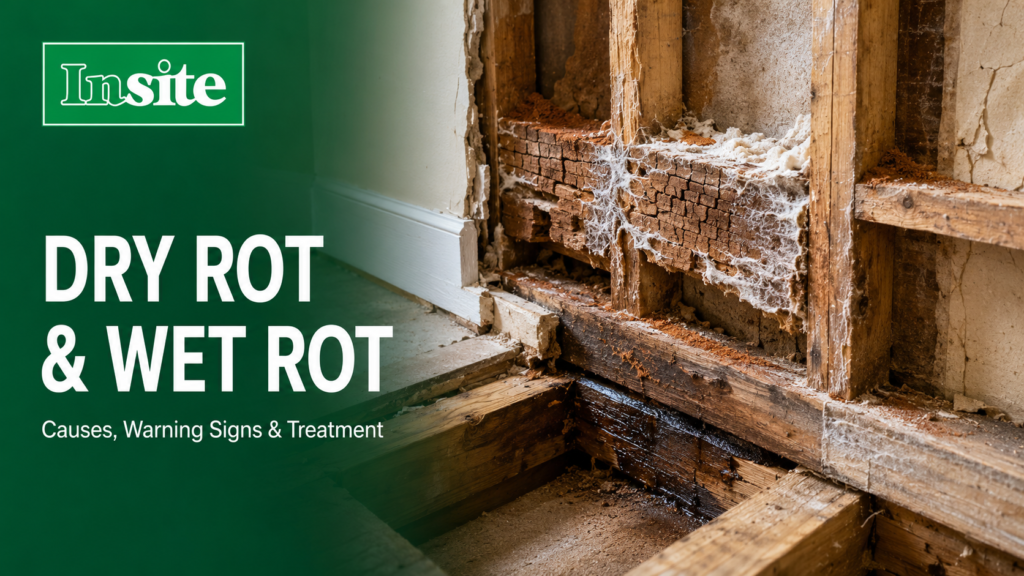
Timber is widely used throughout buildings in floorboards, joists, roof structures, staircases, skirting boards and wall panelling. Although properly maintained timber can remain strong for many years, prolonged exposure to moisture may create ideal conditions for fungal decay.
Dry rot and wet rot are common terms used to describe fungi that attack damp timber. Surveys frequently uncover some form of fungal decay, particularly in older properties or buildings affected by leaks, poor ventilation or defective damp-proofing. If left untreated, timber decay can cause serious structural damage and lead to costly repairs.
Dry rot is generally regarded as the more destructive form because it can spread beyond the original source of moisture and travel through cracks, plaster and masonry in search of additional timber. Wet rot is more common but usually remains close to the persistently damp area.
Understanding the difference between dry rot and wet rot is essential for choosing the correct treatment.
What Causes Timber Decay?
Fungal decay develops when timber contains sufficient moisture for spores to germinate and grow. Fungal spores occur naturally in the environment and may enter a building through air movement or be carried by people and animals.
The spores do not normally damage dry, well-ventilated timber. Problems begin when timber remains damp for an extended period.
Common causes of excessive moisture include:
- Leaking roofs, gutters and downpipes
- Defective plumbing or overflowing appliances
- Damaged flashing around roofs and chimneys
- Ineffective or bridged damp-proof courses
- Blocked airbricks and inadequate subfloor ventilation
- High external ground levels
- Condensation within poorly ventilated spaces
- Water entering through damaged render or masonry
- Timber positioned in direct contact with damp walls
- Flooding or unresolved water damage
Treating the visible fungus without finding and correcting its moisture source will rarely provide a lasting solution. Proper diagnosis must therefore be the first stage of any timber treatment programme.
What Is Dry Rot?
Dry rot is caused by the fungus Serpula lacrymans. Despite its name, it does not begin in completely dry timber. It requires damp conditions to germinate and usually attacks wood with a moisture content of approximately 20 per cent or more.
Once the fungal spores germinate, fine strands known as hyphae penetrate the timber. These strands release enzymes that break down the structure of the wood, allowing the fungus to extract nutrients.
As the outbreak advances, the hyphae combine to create a larger network called mycelium. This may appear as white, grey or cream-coloured sheets across timber, masonry or plaster. In particularly damp conditions, the growth may look soft, white and cotton-like.
Dry rot can spread quickly in favourable conditions. Its strands may travel through cracks and across non-timber materials such as brickwork, concrete and plaster to reach another source of damp wood. Although the fungus does not consume masonry, its ability to cross it makes an outbreak difficult to contain without specialist treatment.
Common Signs of Dry Rot
Dry rot can develop behind wall panelling, beneath floors or within other concealed areas. By the time the problem becomes visible, significant timber damage may already have occurred.
Warning signs include:
- White or grey sheets of mycelium
- Fine fungal strands spreading across masonry
- Timber that appears dry, brittle and weakened
- Deep cracks forming across the grain of the wood
- Timber breaking into small cube-shaped sections
- A damp, musty or mushroom-like smell
- Orange or rust-coloured spore dust
- Fruiting bodies with a reddish-brown centre
- Skirting boards, floors or panelling becoming loose
- Timber shrinking, darkening or crumbling when touched
Fruiting bodies, sometimes called sporophores, may form during an advanced outbreak. These produce large quantities of rust-red spores that can settle as visible dust across nearby surfaces.
Why Is Dry Rot So Destructive?
Dry rot attacks the structural components within timber, gradually reducing strong wood to a dry and brittle mass. Floor joists, roof timbers and other load-bearing elements can lose a substantial amount of their strength before the full extent of the damage becomes obvious.
The fungus can also continue spreading into concealed spaces if suitable moisture conditions remain. Simply removing one visibly affected board may therefore leave fungal growth elsewhere in the building.
A professional investigation should trace the outbreak beyond the immediately visible area. Wall panelling, plaster or flooring may need to be opened carefully so that hidden mycelium and damaged timber can be assessed.
What Is Wet Rot?
Wet rot is a general term covering several fungi that affect timber exposed to persistent moisture. One commonly encountered species is Coniophora puteana, sometimes known as cellar fungus.
Wet rot is more common than dry rot but is generally less difficult to eradicate. It usually remains confined to the damp area because it requires a consistently high moisture level to survive and does not typically travel through masonry in the same way as dry rot.
This means that a wet rot outbreak is often found close to an identifiable defect, such as a leaking pipe, damaged gutter, poorly sealed window or inadequately ventilated floor void.
Common Signs of Wet Rot
The appearance of wet rot varies according to the fungus involved and the type of timber affected. Possible signs include:
- Timber that feels soft or spongy
- Darkened or bleached areas of wood
- Surface cracking or distortion
- Flaking, crumbling or fibrous timber
- A damp and musty smell
- Localised fungal growth
- Paintwork becoming damaged or lifting
- Floors moving or feeling unstable
- Timber losing strength around a leak
- Visible moisture close to the affected area
Some wet rot fungi cause the timber to become darker and split, while others leave it pale with a fibrous texture. A specialist assessment may be needed to identify the type of decay accurately.
Dry Rot Versus Wet Rot
Both types of decay require moisture, but their behaviour is different.
Dry rot can spread away from the original damp area by travelling across masonry and plaster to reach other timber. It may cause extensive damage across several parts of a property.
Wet rot normally stays close to its moisture source and affects timber that remains persistently damp. Treatment is often more localised, although severely damaged structural timber may still require replacement.
Correct identification is important because mistaking one form of decay for another could result in incomplete treatment and continuing damage.
How Is Fungal Decay Treated?
The treatment should begin with a detailed inspection of the affected and surrounding areas. Moisture readings, visual evidence and the condition of concealed timber can help establish the type and extent of the problem.
Treatment may include:
- Finding and repairing the source of moisture.
- Improving ventilation around the affected timber.
- Exposing concealed areas to determine the full extent of decay.
- Removing timber that has lost its structural integrity.
- Treating retained timber and surrounding areas where appropriate.
- Replacing damaged sections with suitable treated timber.
- Allowing walls and structural materials to dry properly.
- Restoring plaster, panelling, floors and decorative finishes.
Dry rot treatment may require a wider area to be opened because fungal strands can extend beyond the visibly damaged timber. The precise approach should be based on the building construction and findings of the survey rather than a standard treatment applied without investigation.
How Can Dry Rot and Wet Rot Be Prevented?
Keeping timber dry is the most effective form of prevention. Roof defects, leaking pipes and damaged gutters should be repaired promptly before moisture reaches concealed woodwork.
Airbricks and subfloor vents should remain clear, and external ground levels should not bridge the damp-proof course. Rooms, roof spaces and suspended floors also require suitable ventilation to prevent trapped moisture.
Property owners should investigate musty odours, unexplained staining, soft timber or movement in floors instead of waiting for the damage to become severe. Regular maintenance can often identify small defects before fungal decay becomes established.
Arrange a Professional Timber Inspection
Dry rot and wet rot should never be treated as surface-level problems. Successful eradication depends on correctly identifying the fungus, tracing the moisture source and establishing how much timber has been affected.
If you have discovered fungal growth, brittle timber, rust-coloured spores or unexplained dampness within your property, arrange a professional inspection. Early diagnosis and appropriate treatment can help limit further decay, protect structural timber and restore a safer, drier environment.
